
Breadcrumbs
These links will help you get back to where you want to go faster.
Why Is My Home Humid After Monsoon Rain?
Navigating Humidity Control and HVAC Maintenance During Phoenix’s Monsoon Season
Navigating Humidity Control and HVAC Maintenance During Phoenix’s Monsoon Season
Every year, from mid-June through September, Phoenix residents face a dramatic change in humidity that transforms their usually dry desert homes into uncomfortably humid spaces. The North American Monsoon brings sudden, intense thunderstorms that elevate relative humidity from less than 15% to over 50% within mere hours. This surge poses serious challenges not only for your comfort but for the performance and lifespan of your HVAC system, indoor air quality, and even your home’s structural integrity. If you’ve noticed your air conditioner running constantly yet failing to banish that sticky, clammy feeling, you’re experiencing a widespread problem unique to the Arizona monsoon season.
NADCA Certified residential air duct cleaning and commercial air duct cleaning technicians can tackle some of the toughest jobs. Are you looking for an air duct cleaner near you in the Major Metropolitan Phoenix area? Call 602-613-0640 or schedule an appointment online.
What you will learn in this article:
– Phoenix experiences a significant rise in humidity during the North American Monsoon (mid-June to September), with outdoor humidity jumping from around 10-15% to over 50-70% rapidly, creating indoor comfort and HVAC challenges.
– Phoenix air conditioning systems are typically designed for dry climates, focusing on sensible cooling (temperature reduction) rather than latent cooling (moisture removal), leading to homes feeling cool yet clammy during monsoon humidity spikes.
– Common HVAC issues during monsoon season include oversized AC units causing short cycling, inadequate latent capacity for moisture removal, dirty air filters restricting airflow, and leaky or poorly insulated ductwork allowing humid air infiltration.

– Dust accumulation inside ducts and exhaust fans further restricts airflow by up to 20%, increasing condensation, fostering mold growth, and diminishing HVAC efficacy.
– Mold thrives in humid indoor environments above 60%, especially in HVAC components like evaporator coils, drain pans, condensate lines, ductwork, and air filters, posing health risks including allergic reactions and respiratory issues.
– Professional duct cleaning uses specialized tools (HEPA vacuums, rotating brushes, cameras) to remove deep-seated dust, pet hair, and debris, improving airflow, reducing energy costs, enhancing moisture removal, and limiting mold growth.
– Bathroom and kitchen exhaust fans are crucial for moisture removal; regular cleaning prevents grease and dust buildup, restores airflow, reduces energy use, and prevents humid air recirculation.
– Indoor humidity should be maintained between 30% and 50% for comfort and mold prevention, using measures such as humidity monitors, running exhaust fans, regular air filter changes (MERV 8 or higher), duct sealing, and possibly whole-home dehumidifiers.
– Effective pre-monsoon maintenance (April-June) includes duct and exhaust fan cleaning, filter upgrades, evaporator coil cleaning, drain line clearing, and duct sealing; post-monsoon maintenance (October) involves re-cleaning and inspecting for moisture-related damage.
Understanding the Monsoon Effect on Indoor Humidity
The Dynamics of Arizona’s Monsoon Season
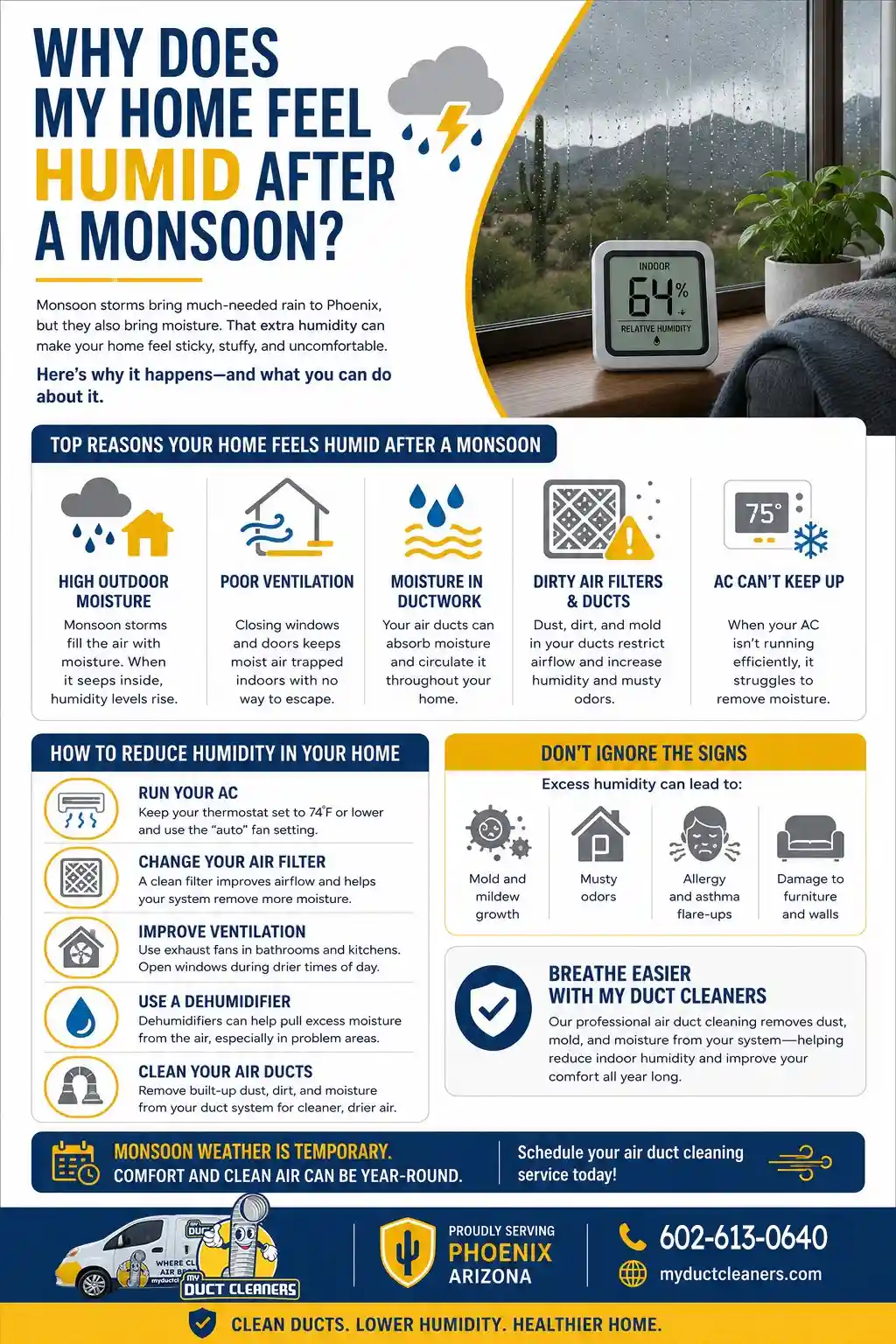
The North American Monsoon is a climatic phenomenon that dramatically reshapes moisture patterns in the Desert Southwest. Moist air is pulled northward from the Gulf of California and the Gulf of Mexico as a low-pressure trough forms over the Four Corners region due to intense solar heating. July and August alone can contribute up to 50% of Arizona’s annual rainfall, often delivering sudden, heavy thunderstorms accompanied by sustained high humidity that lasts for hours or even days.
Notably, research from Arizona State University’s DUSTIEAIM study reveals that urban growth, extreme heat, and dust patterns have altered how these storms form and intensify over Phoenix, underscoring the evolving nature of moisture challenges homeowners face.
The Immediate Humidity Spike and Its Impact on Your Home
Pre-monsoon conditions typically keep Phoenix’s outdoor relative humidity around 10-15%, but monsoon storms can send this soaring above 50-70% in minutes. Your home’s air conditioning system, designed primarily for the region’s dry climate, struggles to keep up. While many Phoenix AC units are sized generously for sensible cooling—that is, lowering air temperature—they tend to be undersized for latent cooling, which removes moisture from the air. The result is a home that may feel cooler but remains damp and uncomfortable, as the AC shuts off before fully removing moisture.
Why Your HVAC System Struggles with Monsoon Moisture
How Air Conditioning Removes Humidity
Your AC’s refrigeration cycle is responsible for dehumidifying indoor air by condensing moisture on cold evaporator coils, which then drains away through the condensate line. However, efficient dehumidification requires sustained system runtime; short cycling disrupts this process, leaving your indoor air clammy and moist despite an operational AC.
How Air Conditioning Removes Humidity
Your AC’s refrigeration cycle is responsible for dehumidifying indoor air by condensing moisture on cold evaporator coils, which then drains away through the condensate line. However, efficient dehumidification requires sustained system runtime; short cycling disrupts this process, leaving your indoor air clammy and moist despite an operational AC.
Common Reasons AC Units Fall Short During Monsoons
| Problem | Effect on Home | Impact on Humidity Control |
|---|---|---|
| Oversized AC Unit | Cools space rapidly and turns off prematurely | Insufficient moisture removal; indoor air stays humid |
| Inadequate Latent Load Capacity | Designed for dry desert air, not monsoon humidity spikes | System can’t remove moisture fast enough during humidity events |
| Dirty or Clogged Air Filters | Restricts airflow causing uneven cooling zones | Condensation forms inside ducts; pockets of humidity linger |
| Leaky or Poorly Insulated Ductwork | Allows humid outdoor air infiltration; surface condensation develops | Increases indoor humidity and creates mold-friendly conditions inside ducts |
How Dusty Ducts and Exhaust Fans Amplify Humidity Problems
Even a thin, unnoticed layer of dust inside your air ducts can reduce airflow by up to 20%, severely impacting HVAC performance. Dust accumulation restricts air movement, forcing the system to operate longer and less efficiently while increasing condensation on duct surfaces. This trapped moisture fosters mold growth and disperses spores throughout your home.

Similarly, bathroom and kitchen exhaust fans—crucial for expelling indoor moisture—lose efficiency when coated with dust, grease, or debris. Such buildup hampers airflow and may cause backdrafting, recirculating humid air into your living spaces, which further raises indoor humidity levels.
The Health and Structural Risks of Excessive Humidity and Mold
Why High Humidity Breeds Mold Inside HVAC Systems
Mold thrives when indoor humidity exceeds 60%, feeding off organic debris such as dust, insulation, and wood present in HVAC components. The evaporator coil, drain pan, condensate line, and ductwork provide ideal moist conditions during monsoon season, enabling mold to colonize and spread spores throughout your home’s air circulation.
Mold Hotspots Within Your HVAC System
| HVAC Component | Why Mold Grows There | Health & Efficiency Consequences |
|---|---|---|
| Evaporator Coil | Condensation forms continuously; drain pan may trap stagnant water | Circulates spores throughout home, reducing air quality |
| Drain Pan & Condensate Line | Clogged by dust and debris, creating stagnant water pools | Spreads contaminants, impairs moisture removal |
| Ductwork (especially attics & crawlspaces) | Surface condensation and leaks introduce humid air | Distributes mold spores into living spaces |
| Air Filters | Restricted airflow causes localized cold spots and condensation | Mold spores bypass filters, contributing to indoor contamination |
Health Implications of HVAC Mold Exposure
The U.S. EPA highlights mold’s capacity to release allergens, irritants, and potentially toxic mycotoxins, which exacerbate respiratory conditions. Exposure often manifests as allergic reactions (sneezing, irritated eyes, skin), asthma attacks, and respiratory irritation. Vulnerable populations—children, elderly, and individuals with compromised immune systems—are at greater risk of long-term health complications.
Because mold in ducts spreads allergens throughout your home, contamination often goes undetected until symptoms become serious, increasing the urgency for proactive HVAC maintenance.
Why Professional Duct Cleaning and Exhaust Fan Maintenance Are Essential
The EPA’s Stance and Best Practices for HVAC Cleanliness
While duct cleaning alone hasn’t been definitively proven to prevent health problems, the U.S. EPA strongly recommends cleaning cooling coils, fans, and heat exchangers to boost system efficiency and moisture control. Maintaining cleanliness is especially critical during monsoon season when humidity management is vital.
Benefits of Professional Duct Cleaning
Expert technicians employ specialized tools such as high-powered HEPA vacuums, rotating brushes, air whips, and inspection cameras to deep-clean your entire duct system. Thorough cleaning removes trapped dust, pet hair, and debris that DIY methods often miss.
Clean ducts provide:
- Improved airflow, reducing system runtime and energy consumption.
- Enhanced moisture removal efficiency, preventing clamminess.
- Lower condensation risks by avoiding localized cold spots.
- Reduced mold growth potential by eliminating dust reservoirs.
- Shorter cooling cycles and faster temperature achievement.
Exhaust Fan Cleaning: Restoring Your Home’s First Line of Defense
Bathroom and kitchen exhaust fans are critical for expelling moisture but become less effective when coated in grease, dust, or debris. Cleaning these fans improves airflow, reduces motor strain, and prevents humid air from recirculating indoors. Professional cleaning extends fan lifespan, reduces energy usage, and plays a key role in maintaining indoor humidity within EPA guidelines.
Optimal Indoor Humidity Levels and Control Strategies for Phoenix Homes
Recommended Humidity Range
The U.S. EPA and ASHRAE recommend keeping indoor humidity between 30% and 50% to minimize mold risks and ensure occupant comfort. This range is especially crucial during the moisture-heavy monsoon months.
Effective Humidity Monitoring and Management Techniques
| Action | Cost & Effort | Impact on Humidity |
|---|---|---|
| Install a Humidity Monitor | Under $50; place in living spaces and near air handlers | Provides real-time insight to prevent unsafe humidity spikes |
| Run Exhaust Fans During and After Showers | No extra cost with existing equipment | Removes 15-20% of indoor moisture, reducing overall humidity |
| Regular Exhaust Fan Cleaning | $150-$300 annually | Maintains maximum moisture removal efficiency |
| Monthly Air Filter Replacement (MERV 8 or higher) | $15-$25 per filter | Ensures consistent airflow and prevents moisture-holding dust buildup |
| Whole-Home Dehumidifier Installation | $1,500-$3,500 installed; $20-$50/month to operate | Supplemental moisture control beyond AC capacity |
| Ductwork Leak Sealing | $200-$600+ professionally | Prevents humid outdoor air infiltration, enhancing system performance |
Two-Cycle HVAC Maintenance: Pre- and Post-Monsoon Strategies
Pre-Monsoon Preparation (April to June)
Proactive maintenance before monsoon rains helps your system withstand humidity stress. Recommended steps include:
- Professional duct cleaning to remove dust and debris buildup
- Thorough exhaust fan cleaning in bathrooms and kitchens
- Evaporator coil cleaning for optimal moisture removal
- Upgrading air filters to MERV 11 or 13 (compatible with your HVAC system)
- Condensate drain line inspection and clearing to avoid clogs
- Inspecting ductwork sealing and insulation, focusing on attics and crawlspaces
Post-Monsoon Maintenance (October)
After the monsoon season, inspection and cleaning address accumulated damage and prepare your system for dry months. This includes:
- Re-cleaning ductwork to remove monsoon-related dust infiltration
- Flushing condensate drain lines to prevent algae and mold growth
- Inspecting evaporator coils for mold or discoloration
- Assessing control boards for electrical damage caused by lightning
- Checking ductwork moisture levels and insulation integrity
How to Prepare Your Home Before Monsoon Season
Taking timely action before monsoon rains hit offers the best chance for maintaining a cool, dry home.
Immediate Actions (This Week)
- Schedule professional air duct cleaning with My Duct Cleaners, LLC.
- Clean bathroom and kitchen exhaust fans
- Replace or upgrade air filters to MERV 11 or 13
- Purchase and install a humidity monitor in key living areas
Short-Term Actions (Before June 15)
- Book a pre-monsoon HVAC tune-up with a licensed technician
- Inspect and clean condensate drain lines
- Examine attic and crawlspace ductwork for dust and mold
- Ensure all exhaust fans operate correctly
Ongoing Monsoon Season Habits
- Monitor indoor humidity daily, aiming to keep it between 30-50%
- Run exhaust fans during and for 20 minutes after showers and cooking
- Replace air filters every 1-2 months if using higher MERV ratings
- Report musty odors, visible mold, or humidity concerns promptly to My Duct Cleaners, LLC.
Common Monsoon-Related HVAC Issues and Practical Solutions
| Problem | Cause | Recommended Solution |
|---|---|---|
| Cool yet Humid Indoor Air; Constant AC Running | Oversized AC unit or leaky ducts cause short cycling before humidity removal | Duct sealing; consider whole-home dehumidifier installation |
| Musty Odors When AC Starts | Mold growth in evaporator coil, drain pan, or ducts | Professional duct and coil cleaning; condensate line inspection |
| Water Stains Near Ducts on Ceiling or Walls | Condensation on uninsulated ductwork located in attics or crawlspaces | Repair duct insulation; improve humidity control strategies |
| Visible Dust Around Air Vents | Dirty air filters or dust escaping from contaminated ducts | Replace filters regularly; schedule professional duct cleaning |
| Weak Airflow From Some Vents | Kinked ducts or dust buildup limiting air movement | Duct cleaning and inspection; repair duct issues |
| Worsening Allergy and Respiratory Symptoms | Mold spores circulating via contaminated HVAC system | Comprehensive duct cleaning, coil disinfection, humidity management |
Why Choose Professional HVAC Cleaning Over DIY
Many homeowners attempt self-cleaning with household vacuums or compressed air, but these methods often fail to do the proper job removing deep-seated contamination and can even spread dust into living spaces. My Duct Cleaners, LLC. uses commercial-grade HEPA-filtered vacuums, specialized agitation tools, and inspection cameras to ensure complete removal of debris while verifying duct integrity.
When working with experts like My Duct Cleaners, LLC, you benefit from:
- Thorough removal of dust, pet dander, and biological debris
- Enhanced HVAC efficiency and lower energy expenses
- More effective humidity control during monsoon season
- Proactive mold prevention to safeguard health
- Peace of mind knowing indoor air quality has improved
The Financial Value of Pre-Monsoon HVAC Maintenance
| Consequence | Potential Cost |
|---|---|
| Mold Remediation in HVAC System | $500 to over $6,000 depending on severity |
| AC Repair or Premature Replacement | $3,000 to $8,000+ |
| Emergency Service Callouts | $150 to $300+ per visit during peak monsoon season |
| Structural Water Damage | $1,000 to over $15,000 |
| Medical Expenses Due to Poor Indoor Air Quality | Hundreds to thousands annually |
| Higher Energy Bills from Inefficient HVAC Operation | $200 to $500+ extra each summer |
Investing in professional care not only prevents costly repairs but improves system lifespan, reduces energy consumption, and protects your family’s health.
Proactive Humidity Management Is Key to Comfortable, Healthy Phoenix Living
Phoenix’s monsoon season challenges homeowners with sudden, intense humidity spikes that expose vulnerabilities in standard air conditioning systems and household ventilation. Understanding how monsoon weather impacts indoor air quality and HVAC system performance empowers you to take informed, proactive steps.
Regular professional duct and exhaust fan cleaning, timely maintenance before and after the monsoon, humidity monitoring, and targeted upgrades like whole-home dehumidifiers and duct sealing form a holistic defense against indoor humidity woes. By acting early and partnering with My Duct Cleaners, LLC. and HVAC partners we trust, you can protect your home’s structure, boost comfort, and safeguard your family’s health during the sticky Phoenix monsoon months.

Don’t let post-rain moisture turn your desert home into a swampy and uncomfortable environment. Invest in comprehensive air duct cleaning and HVAC exhaust fan cleaning and enjoy fresh, dry, and healthy air all monsoon season long.
NADCA Certified residential air duct cleaning and commercial air duct cleaning technicians can tackle some of the toughest jobs. Are you looking for an air duct cleaner near you in the Major Metropolitan Phoenix area? Call 602-613-0640 or schedule an appointment online.